|
|
|
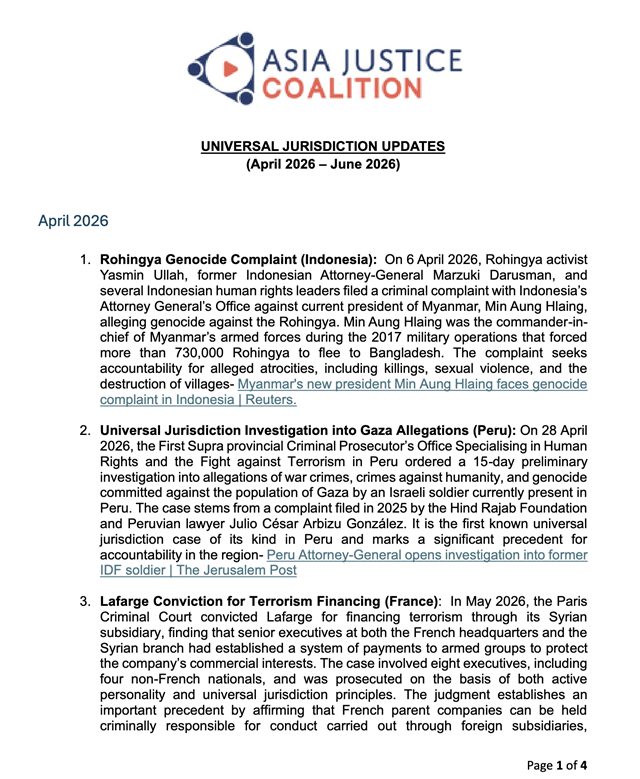
AJC UNIVERSAL JURISDICTION QUARTERLY UPDATES
On 16 July, the Asia Justice Coalition released its quarterly Universal Jurisdiction Updates (April – June 2026). AJC gathers, curates, and consolidates publicly available information and resources on cases and proceedings filed under the principle of universal jurisdiction for atrocity crimes to advance international justice and accountability across the globe, including Asia. This project is in partnership with Associate Professor Dr. Emma Palmer and Prasadi Wijesinghe of Griffith University, whose work is supported by the Australian Research Council Discovery Early Career Award. Subscribe to AJC’s Justice and Accountability Google Group to receive the updates in your inbox.
DR. PRIYA PILLAI PARTICIPATED IN A CONVENING ON TRANSITIONAL JUSTICE
On 8-10 July, Asia Justice Coalition Executive Director Dr Priya Pillai participated in a dialogue convened by Wilton Park and the British Foreign, Commonwealth & Development Office on 'Transitional Justice in Contemporary Conflict Resolution' in the UK. Dr Pillai presented on a panel titled 'Transitional Justice: Shifting Foundations?' and explored four aspects - mapping the landscape, the evolution of transitional justice, international law and its 'imminent demise’, and the democratic deficit and operating environment.
|
|
|
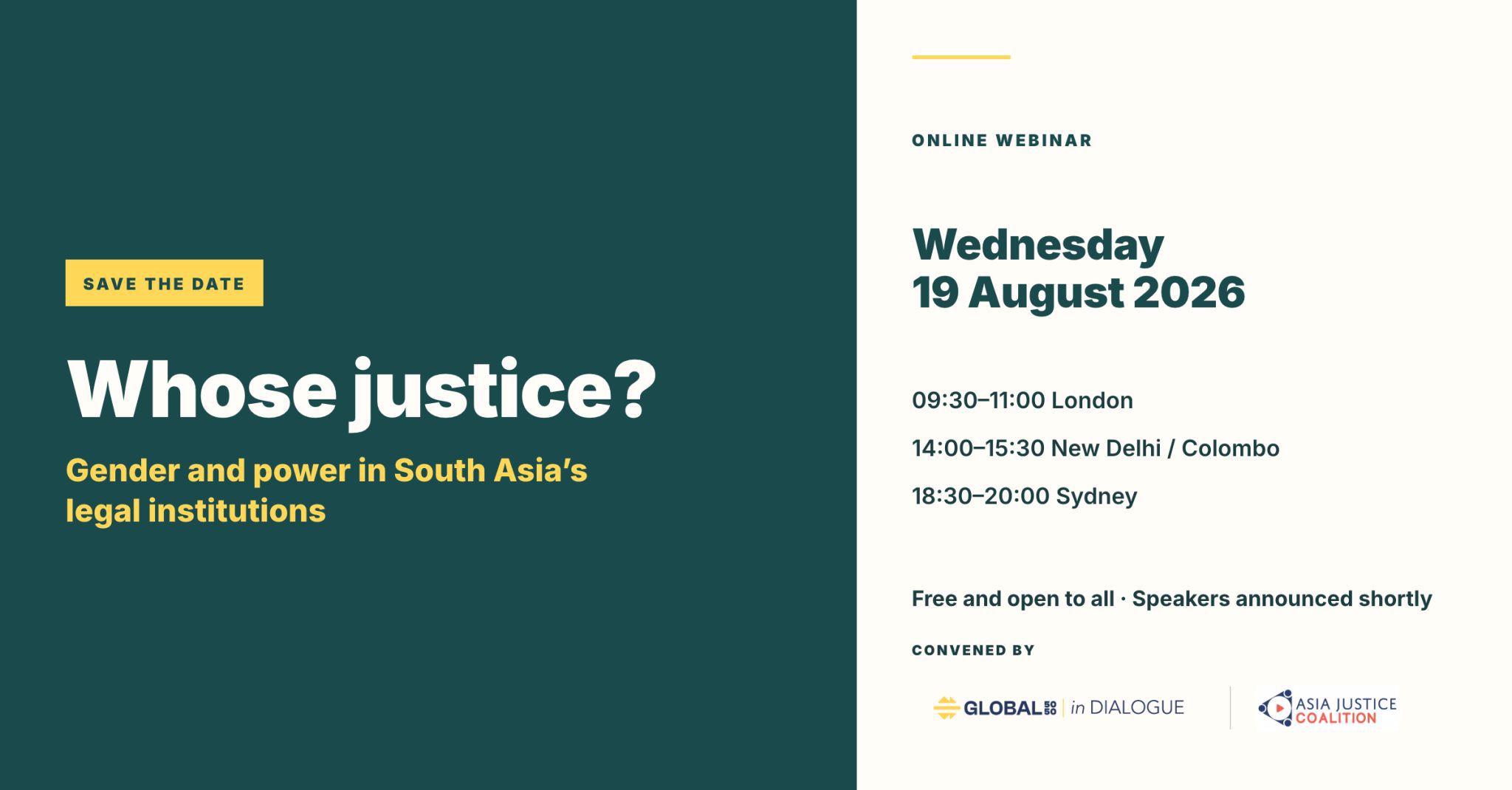
AJC & GLOBAL 50/50 WEBINAR ON GENDER AND POWER IN SOUTH ASIA’S LEGAL INSTITUTIONS
On 19 August, Global 50/50 and Asia Justice Coalition will host a webinar on 'Whose Justice? Gender and power in South Asia's legal institutions' to discuss findings from Global 50/50 Gender (In)Justice? report. To attend, kindly register here.
GENDER JUSTICE IN INTERNATIONAL CRIMINAL LAW CONFERENCE 2026
Asia Justice Coalition is partnering with Legal Action Worldwide, Global Justice Center, Women's Initiatives for Gender Justice, Gender Justice Practitioner Hub (GJPHub), International Institute of Social Studies (ISS) of Erasmus University Rotterdam, and others for the "Gender Justice in International Criminal Law Conference 2026 (6-7 October, The Hague)." This year's focus is on Asia, examining accountability strategies for Afghanistan, Iran, Myanmar and overlooked crises in the region. Moreover, thematic issues, such as people's tribunals, big tech and feminist digital accountability, climate and conflict, and feminist international criminal law, will be centered. To register, click here.
|
|
|---|
|
GJC: UN RECOGNIZES REPRODUCTIVE VIOLENCE AS A DISTINCT FORM OF GBV
On 7 July, the Global Justice Center welcomed the UN Human Rights Council adoption of a resolution on women's and girls' human rights in humanitarian crises that explicitly names reproductive violence as a distinct category of gender-based violence. It is the first UN body to do so. The resolution notes that women and girls in humanitarian situations face heightened risks of all forms of violence and discrimination and are "disproportionately affected by sexual and gender-based violence, including...reproductive violence such as forced or denial of contraception..." According to GJC, “Reproductive violence targets reproductive autonomy, and the resolution makes a clear and important statement by characterizing denying access to contraception as a violation of reproductive autonomy.”
FORTIFY: ‘UK PARLIAMENT SHOULD PASS BILL TO ENSURE GENOCIDE IS RECOGNISED’
On 10 July, ahead of the Second Reading at the House of Lords, Fortify Rights called on the United Kingdom Parliament to pass the Genocide Determination Bill. This bill would give survivors a pathway to seek preliminary genocide determinations through U.K. courts and require the government to take action when such findings are made. According to Fortify, “The Genocide Determination Bill is especially important because the U.K.’s long-standing position has been that genocide is a matter for competent courts rather than political determination. However, in most cases of genocide committed abroad, British courts have no practical mechanism to make such a determination unless the case involves criminal proceedings against British nationals or residents.”
HRW: DEADLY LANDSLIDES IN BANGLADESH HIGHLIGHT URGENT NEED TO REDUCE RISKS FOR ROHINYA REFUGEES
On 13 July, Human Rights Watch reported on the deadly risks facing Rohingya refugees in Bangladesh as evident from landslides in July 2026 that killed at least 17 people and displaced more than 3,000. HRW called upon Bangladesh authorities, the UN, and donor governments to reduce overcrowding in the refugee camps and urgently restore aid for embankments, drainage, access routes, and emergency relocation sites. The Rohingya Coordination Platform reported that between July 4 and July 9, there were 286 weather-related incidents across the camps in Cox’s Bazar, affecting 26,119 refugees, including 95 landslides that displaced 4,307 people, partially damaged 2,809 shelters and destroyed 13. According to HRW, “[n]ewly arrived refugees are particularly at risk because they are not allocated formal shelters and end up renting or buying unsafe spaces…”.
ICJ: ‘HUMAN RIGHTS COUNCIL CONCLUDES ITS 62ND SESSION WITH ACTION ON COUNTRY CRISES AND KEY HUMAN RIGHTS CHALLENGES’
At its 62nd session, the Human Rights Council called for accountability for grave violations in Myanmar. The HRC adopted 28 resolutions on country situations and thematic issues, 25 of which were adopted without a vote. The Council adopted a resolution on the human rights of Rohingya Muslims and other minorities in Myanmar, condemning the atrocities committed by parties to the conflict. The ICJ, in its advocacy around the resolution, called for an emphasis on accountability for the military junta, responsible for criminal abuses of human rights and violations of international humanitarian law. The ICJ has emphasized that the return of refugees to Myanmar is only possible when the conditions are met for return to be voluntary, dignified, safe and based on an informed and independent decision. The ICJ welcomes the stress on the critical need for accountability in the resolution, including the progress made in the case
The Gambia v. Myanmar pending before the International Court of Justice.
GCR2P: POPULATIONS AT RISK (MYANMAR)
On 15 July, the Global Centre for the Responsibility to Protect publishes its ‘Populations at Risk’ – country analysis. For each population at risk, it provides detailed
background on the situation; highlights
recent developments in the situation; offers
analysis of the factors and indicators that have enabled the possible commission of mass atrocity crimes or prevented their resolution; provides an
atrocity risk assessment; and suggests
necessary action to prevent or halt the commission of mass atrocity crimes and protect populations. Check the Myanmar situation analysis here.
|
|
|
AI: ‘REPORTED SEA TRAGEDIES HIGHLIGHT DESPERATE CHOICES FACING ROHINGYA’
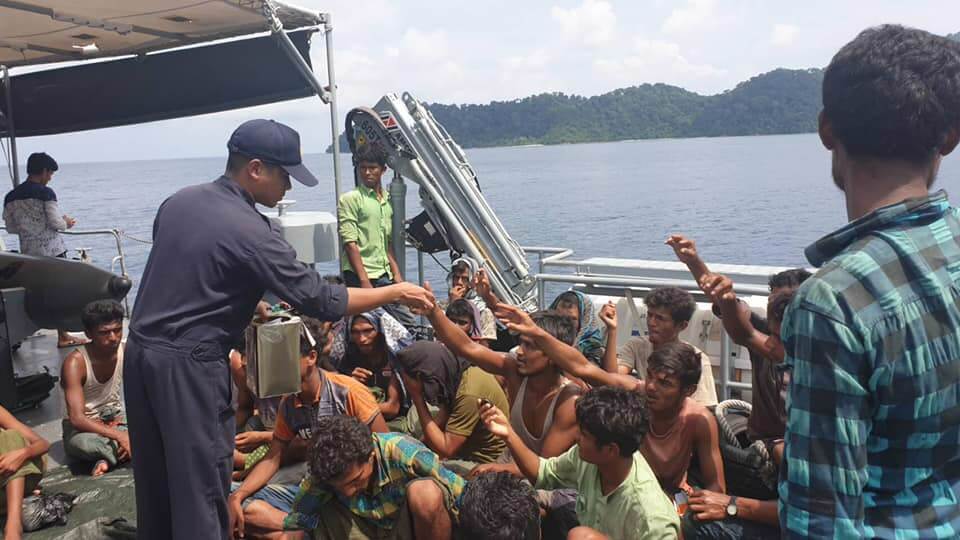
On 16 July, responding to reports that more than 500 people are feared dead after two boats carrying mostly Rohingya refugees capsized off the coast of Myanmar, Amnesty called upon the Bangladesh authorities and the international community to prevent forced repatriation and to strengthen search-and-rescue efforts, ensure timely access to protection for those seeking safety and work together to end the cycle of neglect that continues to put Rohingya lives at risk. According to Amnesty, “Conditions in Rakhine State are not viable for safe and dignified returns as people continue to flee the place the Bangladesh government wants to forcefully repatriate them to.”
BROUK: 'MORE THAN 500 ROHINGYA FEARED DEAD AFTER ARAKAN ARMY FORCED BOAT TO DEPART DESPITE SEVERE WEATHER'
On 16 July, BROUK released a public statement concerning the news report about more than 500 Rohingya feared dead after two boats sank off the coast of Burma. According to BROUK sources, both boats departed from Arakan Army-controlled areas of Rakhine State. The Arakan Army is deeply involved in human trafficking, both profiting from it and facilitating it. According to information received by BROUK, the Arakan Army also facilitated Rohingya reaching and boarding both boats. According to Tun Khin (President, BROUK), “These Rohingya did not die because of dangerous weather at sea. They died because of the policies of the Arakan Army, which tries to force Rohingya to flee and then profits through its involvement in human trafficking when Rohingya do flee.”
FORTIFY: MYANMAR’S RESISTANCE FORCES URGED TO ESTABLISH WAR CRIMES INVESTIGATION UNITS
On 21 July, Fortify Rights urged Myanmar’s resistance organizations to establish independent war crimes investigative units capable of impartially investigating alleged violations of international humanitarian law by all parties to the conflict, including the Myanmar junta as well as resistance forces. The recommendation follows Fortify Rights’ recent laws of war and human rights documentation trainings in Karenni State.
AI: ‘REFUGEE PROTECTION CANNOT BE PAUSED DURING TRANSITION TO DPP SYSTEM’
On 23 July, Amnesty International Malaysia called upon Malaysia to immediately clarify how asylum-seekers are to seek protection while UNHCR registration is suspended, provide transparency on the assessment processes applied to those facing return to Myanmar, and ensure that no one is returned before their protection needs have been fully and fairly assessed. As per Amnesty, the government had directed the United Nations High Commissioner for Refugees to temporarily suspend refugee registration while Malaysia restructures refugee management through the Dokumen Pendaftaran Pelarian (DPP) programme. Further, it was also stated that approximately 5,000 Myanmar nationals currently held in immigration detention are expected to be returned to Myanmar.
GCRP2: SUMMARY OF THE 2026 UN GENERAL ASSEMBLY PLENARY MEETING ON THE RESPONSIBILITY TO PROTECT
On 28 July, the Global Centre for the Responsibility to Protect published a summary of the recently held UN General Assembly plenary meeting on the “Responsibility to Protect (R2P) and the prevention of genocide, war crimes, ethnic cleansing and crimes against humanity” as part of the formal agenda of its 80th session. During the meeting, 50 member states and two (sub) regional organizations – the European Union (EU) and the Intergovernmental Authority on Development (IGAD) – spoke on behalf of 89 countries. Ahead of the meeting, the UN Secretary-General issued the 18th report on the R2P titled
“Sustained implementation of the responsibility to protect at the national, regional and multilateral levels.” The report reflects on lessons learned in operationalizing R2P and emphasizes the need to strengthen implementation through sustained national, regional and multilateral policies and practices.
|
|
|---|
|
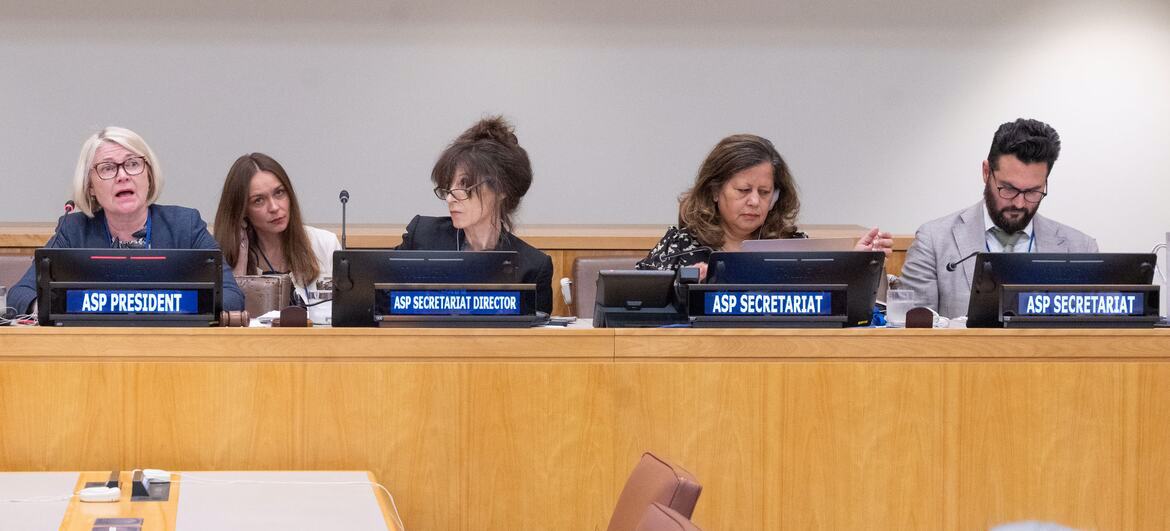
‘ICC PROSECUTOR KARIM KHAN DISMISSED’
On 24 July, the International Criminal Court Assembly of States Parties dismissed its Prosecutor Karim Khan following disciplinary proceedings related to widely reported sexual misconduct allegations at an emergency session at UN Headquarters in New York. The decision was made by simple majority during a closed-door vote among the 125-member Assembly of States Parties to dismiss Mr. Khan, who Member States had elected to serve a nine-year term as the court’s prosecutor in 2021. “The Assembly has decided by a majority of 82 States Parties that…prosecutor Karim Khan committed serious conduct and a serious breach of duty…and to remove [him] from office..”.
STRAITS TIMES: ‘ASEAN HOPES TO SEE PROGRESS ON PEACE PLAN BY MYANMAR’
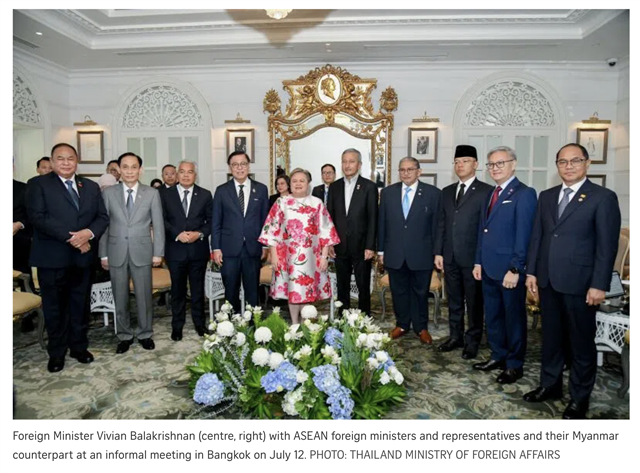
On 12 July, ASEAN foreign ministers and their Myanmar counterpart in Bangkok held a meeting to discuss progress on the Five-Point Consensus (5PC) peace plan, such as the release of all political detainees, including Aung San Suu Kyi. This marked the first in-person meeting between the ASEAN foreign ministers and Myanmar’s top diplomat since the 2021 coup in Myanmar. Singapore Foreign Minister Vivian Balakrishnan said ‘that ASEAN foreign ministers would like to see a permanent end to violence in Myanmar and for ASEAN to be able to deliver humanitarian aid across the country even in places not controlled by the Myanmar regime, which are points mentioned in the peace plan’.
|
|
|
DAILY STAR: ‘PM TO HEAD NATIONAL COMMITTEE ON ROHINGYA REPATRIATION STRATEGY’
On 13 July, the Daily Star reported that the government [of Bangladesh] has formed an 11-member National Strategy Formulation Committee on Rohingya Affairs, headed by Prime Minister Tarique Rahman, to prepare a national strategy for the swift and sustainable repatriation of Rohingyas. According to the notification, the member-secretary, under the direct supervision of the chief coordinator, will form a board to prepare the National Strategy on Rohingya Affairs. The board has been tasked with formulating the strategy within 90 days and submitting it to the National Committee on Rohingya Affairs.
UN EXPERTS URGE ACTION TO END TRAFFICKING AND DEATHS OF ROHINGYAS ON ANDAMAN SEA
On 29 July, UN experts called for urgent action to support the humanitarian response to the hosting of Rohingya refugees in Bangladesh, recognising the shared responsibility of the international community. According to experts, “Statelessness affecting Rohingya refugees and the protracted situation of displacement contributes to serious risks of human trafficking with devastating consequences for victims”. The experts stressed that the lack of opportunities is exploited by trafficking networks, including armed groups and criminal networks, who target Rohingya children and young people, with deceptive offers of employment, education or marriage, and for recruitment and use.
|
|
|---|
|
|
|
|
|  |
|
|
|
|